Adrenaline Diesel Blog
CAN Bus Communication Faults: Why Modules Stop Talking and How Diagnostics Find the Break
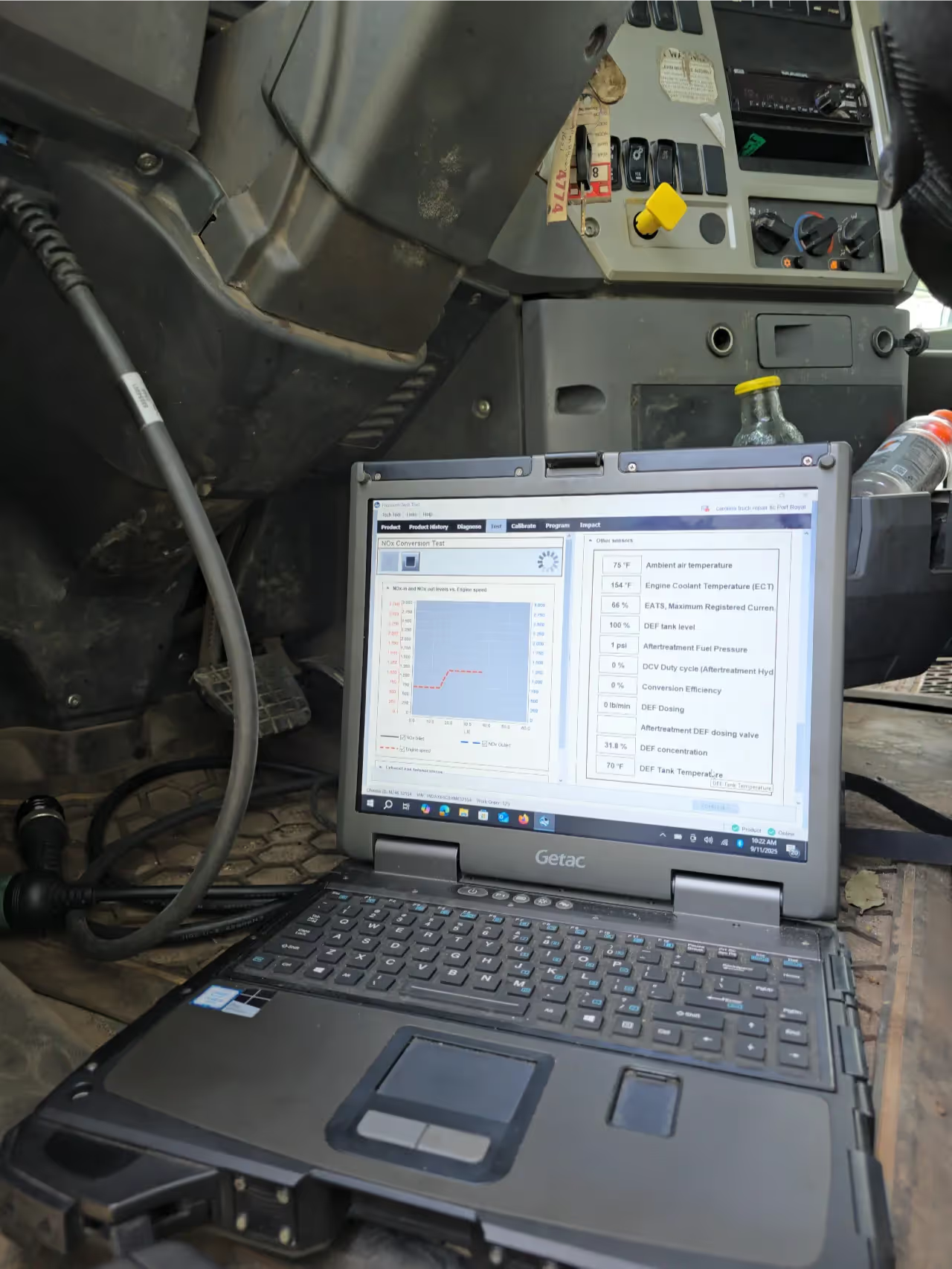
Modern heavy-duty vehicles rely on distributed electronic control units (ECUs) that communicate over a shared network rather than on point-to-point wiring. In most heavy-duty applications, this network is based on the Controller Area Network (CAN) physical layer defined in the ISO 11898 series, with higher-layer protocols such as SAE J1939 commonly used to standardize message formats and diagnostics across ECUs.
When CAN Bus communication faults occur, the impact extends beyond a single malfunctioning feature. A network interruption can ripple through the system, leading to multiple symptoms because modules depend on each other’s broadcast messages to verify sensor data, coordinate torque requests, confirm braking states, and display driver information. In practice, a single physical-layer defect may generate numerous secondary diagnostic trouble codes (DTCs) across unrelated systems, especially when multiple ECUs simultaneously lose access to the same network traffic.
CAN is a serial communication method designed for reliable ECU-to-ECU data transfer. In high-speed CAN systems, data is transmitted over two wires—often called CAN High (CAN-H) and CAN Low (CAN-L)—which carry a differential signal to enhance noise immunity in electrically noisy environments.
SAE J1939 uses CAN as its physical layer and is commonly associated with heavy-duty vehicles. In this setup, ECUs publish and subscribe to standardized messages, allowing multiple controllers to interpret data consistently and supporting interoperability across functions such as engine, transmission, braking, and instrumentation.
From a diagnostic perspective, this shared-bus design is efficient, but it also means that a bus fault can cause multiple “missing message” or “lost communication” issues simultaneously. Since the network is shared, the diagnostic process involves determining whether the failure is due to (1) a physical-layer integrity issue, (2) a power or ground instability that causes modules to reset or go offline, or (3) a malfunctioning node that interferes with communication for other devices.
CAN-related faults often appear intermittently and vary widely. Diagnostic tools might fail to connect to certain modules, or communication with a module could drop during specific conditions such as engine cranking, high electrical load, or vibration. These issues are consistent with physical-layer problems (wiring or termination), node-level failures (transceiver issues), or supply problems (voltage drops) that disrupt stable network operation.
A key practical point is that the symptom set might be broader than the actual fault location. Because heavy-duty systems often use standardized networks for multiple subsystems, the dash, brakes, aftertreatment, and drivetrain controllers can all log complaints when network traffic is disrupted—even if only one point in the network is physically affected. This “many codes from one defect” pattern is common in failures within shared-bus networks.
High-speed CAN relies on the integrity of the twisted-pair conductors and their consistent electrical properties. Physical abrasion, pinched routing, heat exposure, and previous repairs can damage insulation or conductor strands. Even partial conductor damage can degrade signal quality enough to cause intermittent errors, especially under vibration.
CAN networks depend on low-resistance connections at junctions and ECU connectors. Moisture intrusion and corrosion can increase contact resistance, leading to signal distortion or intermittent disconnections. In practical diagnostics, corrosion-related issues are often identified through visual inspection combined with electrical tests that vary when the connector is moved or the harness is manipulated.
High-speed CAN requires termination to prevent signal reflections. Industry guidance typically recommends using two termination resistors—usually 120 ohms—placed at the ends of the bus. When measured across CAN-H and CAN-L with power off, this setup results in an expected combined resistance of about 60 ohms, since two 120-ohm resistors in parallel equal approximately 60 ohms.
The importance of termination is directly related to matching the network’s characteristic impedance and reducing reflections that can interfere with signal edges and frames. This is essential for high-speed CAN physical-layer performance and is emphasized in technical guidance on CAN physical-layer design and termination.
A single ECU (or its transceiver circuitry) can impair network communication if it fails by loading the bus, shorting a line, or injecting excessive noise. Practical troubleshooting guides often include node-isolation steps—disconnecting suspect nodes to see if the bus returns to normal—because this is an effective way to identify a transceiver-related issue.
Even when the CAN wiring is intact, ECUs need a stable power supply and proper grounding to stay connected to the network. If a module resets due to undervoltage during cranking or high resistance in its power or ground paths, it might disconnect from the bus or behave intermittently. Therefore, diagnostic procedures prioritize checking power and ground connections before blaming network wiring or modules.
A formal diagnostic approach seeks to turn a broad “communication problem” into a specific, testable failure mode. Professional-guided test procedures focus on physical-layer verification and on repeatable measurements rather than on part substitution.
The diagnostic process starts with a comprehensive network scan that identifies which modules have communication issues and which are completely unreachable. This step determines if the problem is localized (a single module missing) or systemic (several modules unreachable), which significantly impacts the test plan.
Guided diagnostic references usually classify CAN faults into issues with termination or wiring, abnormal voltage levels, and node-level transceiver problems. This classification is practical because each type requires different measurements and expected results, helping technicians quickly identify the causes.
Before conducting intrusive network testing, technicians verify that affected modules have proper supply voltage and grounding under relevant conditions, such as cranking and high-load electrical operation. An underpowered module can imitate a network failure by intermittently disappearing from the scan tool and logging “lost communication” events in other ECUs.
A basic physical-layer check involves measuring resistance between CAN-H and CAN-L with the vehicle turned off. Many service and troubleshooting guides mention that about 60 ohms is the typical reading when two 120-ohm terminations are correctly installed. If the reading is significantly higher, it could indicate a missing termination or an open circuit. If the reading is significantly lower, it might suggest a short or an unintended additional termination.
This single measurement is useful because it tests the entire system for termination and detects many common faults without needing disassembly. However, it does not locate the fault; it shows that additional isolation or segment testing is necessary.
Guided tests with oscilloscopes or multimeters usually check if CAN-H and CAN-L behave as expected, and whether a line is shorted to ground, shorted to power, or biased incorrectly. In practice, a steady abnormal voltage on one line strongly suggests a short or transceiver fault.
Oscilloscope-guided troubleshooting is especially helpful for intermittent faults. By recording a longer time span, the technician can see if the signal amplitude drops, if noise levels rise, or if frames become distorted under certain conditions.
Intermittent CAN faults often happen under vibration or thermal expansion. Troubleshooting methods usually suggest controlled harness movement (“wiggle testing”) while observing network measurements or live data to reproduce the dropout. When a fault can be duplicated, the search area generally narrows down to the manipulated harness segment, connector, or junction.
If resistance or signal tests indicate a bus-level problem, technicians often isolate sections by disconnecting intermediate connectors or nodes (where design allows) to find which branch contains the defect. Node isolation is also used to identify a faulty transceiver: if disconnecting one ECU restores normal bus resistance or signal shape, that ECU (or its wiring) is the main suspect.
A formal repair confirmation involves rechecking baseline tests—such as termination resistance and signal integrity—and verifying that all modules are accessible and stable during a road test or a representative duty cycle. Oscilloscope guidance stresses capturing enough data to confirm consistent frame transmission over time, which boosts confidence that the issue is fixed rather than temporarily hidden.
A common diagnostic mistake is interpreting multiple communication signals as evidence that “multiple modules are bad.” In a shared CAN environment, a single physical issue—such as termination loss, a short circuit, or a disruptive node—can cause multiple system complaints at once. A structured workflow helps prevent unnecessary module replacements by ensuring the bus is electrically sound and that each node functions normally when the network is healthy.
Similarly, a resistance reading near 60 ohms does not guarantee that the bus is healthy under load; it only indicates that termination is likely present. Signal quality assessment (especially with a scope) remains important when faults occur only during operation. Industry oscilloscope guidance explicitly notes the value of capturing and analyzing multiple frames over time to identify rise-time issues, noise, and intermittent corruption.
Although not all CAN faults can be prevented, various controls help lower the risk.
These measures do not eliminate the need for diagnostics, but they lower the chance that the network will be the weak point in vehicle uptime.
CAN Bus communication faults are best understood as issues of network integrity rather than as individual component failures. Since SAE J1939 and similar heavy-duty systems rely on CAN-based communication among multiple ECUs, a single physical-layer issue, a disruptive node, or a power fluctuation can cause widespread and confusing symptoms.
A formal diagnostic process—covering module reachability, verifying power and ground, measuring termination resistance, analyzing bus voltages and waveforms, reproducing intermittency, and isolating nodes—offers an evidence-based way to identify the true break point. This method minimizes unnecessary part replacement and boosts confidence that the repair will stay stable under real operating conditions.
If your fleet or individual truck is experiencing recurring network dropouts, intermittent “lost communication” events, or diagnostic tool connection issues, Adrenaline Diesel in Edmonton, AB can utilize a structured CAN bus diagnostics process to identify the exact failure and confirm the repair under operating conditions.
Give us call or fill out our service request form to schedule your vehicle in for service at Adrenaline Diesel.

Adrenaline Diesel has extended service hours to ensure you get the best appointment time possible.

Sourcing parts for complex jobs is our specialty. We always aim for the fastest turnaround possible.


